
The future belongs to everyone
THE FUTURE BELONGS TO EVERYONE
Every era creates images of what does not yet exist, projecting onto them its fears, desires, and hopes. This section brings together different ways of imagining what is yet to come, from the Space Age culture of the 1960s to the collaborative experiences that gave rise to the Fiat Mio.
At the end of that decade, astronauts, rockets, and space travel held a central place in mass culture. The Space Race transformed technology into a promise of overcoming earthly limits, while also being marked by the tensions of the Cold War and the nuclear threat. Claudio Tozzi appropriates this pop repertoire from a Brazilian perspective — that of someone who followed, through television and the press, a project led by the world’s great powers, yet disseminated as a global spectacle.
In Ciranda na Terra e no Céu (Circle Dance on Earth and in the Sky), Antonio Poteiro proposes another relationship between the planet and the cosmos. In place of the rocket, a circle dance rises skyward, bringing together imagination, community, and spirituality. In Deserto Azul (Blue Desert), Eder Santos presents an arid and dehumanized landscape, where the search for transcendence seems to remain unanswered.
The Fiat Mio concludes the section with an open question: how can we imagine the car of tomorrow? Developed through the contributions of thousands of people, the project transformed collective participation into design, form, and prototype. By turning the contributions of thousands of people into design, form, and prototype, the Mio proposes an idea of the future built collectively. Imagining the car of tomorrow becomes, here, an exercise in listening, participation, and shared creation.
ARTWORKS
Central de transmissão (Broadcast Center)
Claudio Tozzi, 1969
Acrylic on Eucatex board
Lili and João Avelar Collection
Credit: Daniel Mansur
Deserto Azul (Blue Desert)
Eder Santos, 2026
Video, running time: 7 minutes
Artist’s Collection
Cast: Odilon Esteves and Daniel Toledo
Original music: Stephen Vitiello
Producer: Beatriz Flecha
Editing and visual effects: Eder Santos, Barão Fonseca and Leandro Aragão
Assistant editor: Isabel Moreira
Production company: Trem Chic
Ciranda no Céu e na Terra (Circle Dance in Heaven and on Earth)
Antônio Poteiro, 1996
Oil on canvas
Errol Flynn Art Gallery
Sem título (Untitled)
Alfredo Volpi, 1940s
Paint on ceramic tile — Osirarte
Orandi Momesso Collection
Sem título (Untitled)
Alfredo Volpi, 1940s
Paint on ceramic tile — Osirarte
Orandi Momesso Collection
Desenho com dois títulos, ambos riscados (Drawing with Two Titles, Both Crossed Out)
Milton Machado, 2018
Drawing, India ink on paper
Viagem (Journey)
Claudio Tozzi, 1967
Liquitex on panel
Regina Scavone Collection
Módulo Lunar (Lunar Module)
Claudio Tozzi, 1972/73
Acrylic on canvas mounted on panel
Courtesy of Galeria Houssein Jarouche
THINKING ABOUT THE FUTURE
The Fiat Mio was created in 2010 as the world’s first collaboratively developed concept car. Around 11,000 ideas were submitted by an online community, where 17,000 members from 160 countries generated more than 2.3 million visits — an outstanding achievement for the time. It was the first time an automotive company had embraced the power of virtual collaboration to develop a vehicle concept.
This Brazilian initiative challenged the project team to transform a wide range of contributions into a single concept through an open and experimental approach. Every stage of the development process — from the creation of the digital community to the media coverage of its unveiling at the International Motor Show — was shared online and published on YouTube, accumulating more than 1.1 million views worldwide.
The project also anticipated discussions about sustainable mobility, technology, and the relationship between users and their vehicles. As a result, the Fiat Mio became a landmark in open innovation, demonstrating that product development can extend far beyond traditional engineering teams.
This project is part of Fiat’s long-standing tradition of exploring new ideas through concept cars, as illustrated by the examples alongside.
PHOTOS AND CAR
FIAT SCIA
Design: Peter Fassbender and John Kinsey
Exterior design
Darrin Caddes
Interior design
Centro Stile Fiat
Italy
1993
Conceived as an extension of the lifestyle of its time, the model stood out for its experimental design, translated into an emotional, fluid, and organic visual language.
FIAT TREPIÙNO
Design: Roberto Giolito
Italy
2004
The model was created with the aim of restoring an emotional connection with the public, using design as a central pillar of brand identity. This aesthetic manifesto became timeless by using the platform of the iconic modern Fiat 500 as its foundation.
FIAT MIO
The Mio was created in 2010 at the Fiat Design Center as a collaborative design proposal developed together with the brand’s enthusiasts online. This open and dynamic process involved around 17,000 participants from 160 countries, who collectively reflected on mobility. A unique milestone and a vision of the future that remains relevant today.
2010
Collection: Design Center South America
FIAT CENTOVENTI
Design: Klaus Busse
Centro Stile Fiat
Italy
2019
A revolutionary automobile concept conceived as a modular and fully customizable platform. The project materializes the celebrated “less is more” philosophy, in which aesthetic minimalism meets maximum functional versatility.
FIAT TURBINA
Design: Luigi Rapi
Italy
1954
Ahead of its time, this concept tested limits by adopting a gas turbine and extreme aerodynamics. Its avant-garde design directly reflects the influence and optimism of the aerospace age.
FIAT X1/23
Design: Gian Paolo Boano
Centro Stile Fiat
Italy
1972
Designed from the perspective of urban efficiency and sustainability, the model stands out as one of the first ultra-compact electric vehicle concepts in automotive history.
FIAT 126 CITY
Design: Giovanni Michelotti
Centro Stile Fiat
Italy
1974
The model emerged from a proposal for accessible and simplified mobility. Its defining feature was the maximum rationalization of the popular urban car.
FIAT DOWNTOWN
Design: Roberto Giolito, under the direction of Chris Bangle
Italy
1993
An extreme response to urban mobility, this microcar innovated through its radical three-seat layout and minimalist dimensions, designed to occupy the smallest possible space on public roads.
THE CAR OF THE FUTURE (INSTALLATION)
What will the next 50 years look like? And what about the car that will take us to our destinations and future achievements? No one really knows. That is exactly where the fun begins.
Now it is your turn.
Bring the car of your dreams to life. There are no right or wrong answers, no limits — only your vision of what lies ahead.
HOW TO PARTICIPATE
- Pick up a sheet with the model of your choice.
- Color it your way, with whatever colors and designs inspire you.
- Take your drawing to the kiosk and press the button to scan it.
- Watch your car come to life on the screen in a city of the future.
Who doesn’t have a good story to tell about a car?
Step inside, take your picture, and share your story with us!
Don’t forget to tag @casafiatdecultura on Instagram.
Praça da Liberdade, nº10, Funcionários | CEP: 30140-010 | Belo Horizonte/MG - Brasil
Tel: +55 (31) 3289-8900
Horário de funcionamento: terça a sexta-feira, das 10h às 21h; sábados, domingos e feriados, das 10h às 18h
Visitas agendadas sob consulta
TODA PROGRAMAÇÃO DA CASA FIAT DE CULTURA É GRATUITA

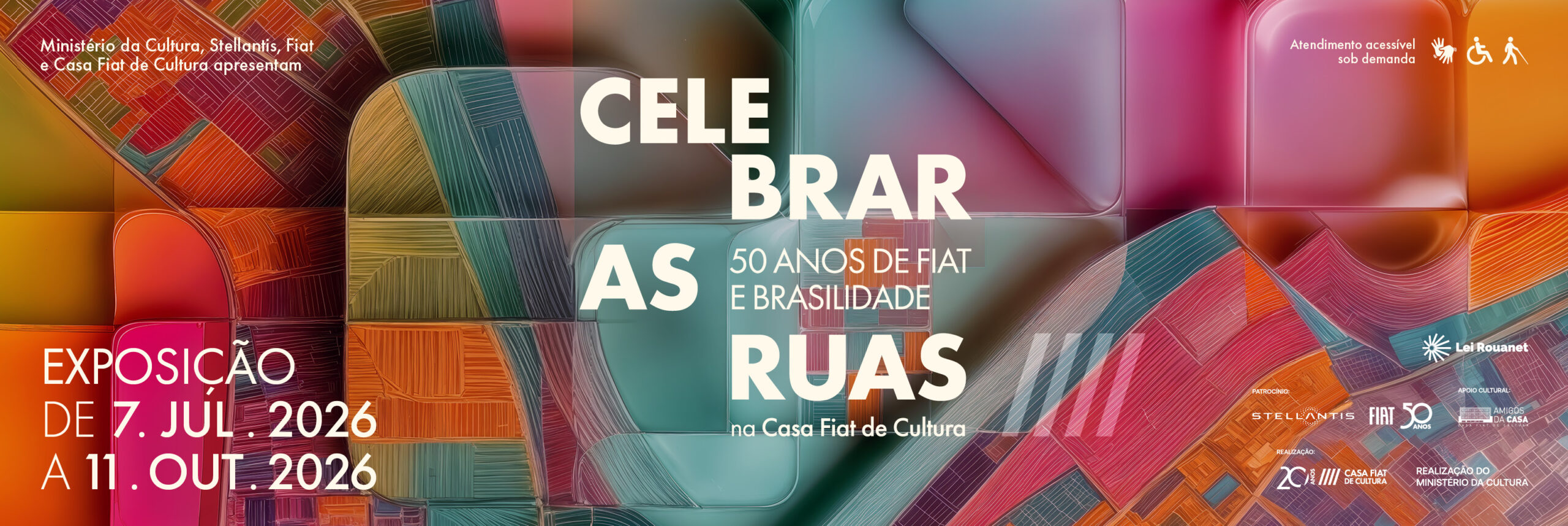
Atendimento acessível sob demanda, mediante disponibilidade da equipe.
Plano Bianual Casa Fiat de Cultura 2026
