
Celebrating the streets, an integrated timeline
CELEBRATING THE STREETS — AN INTEGRATED TIMELINE
THE 1970s — BEGINNINGS, ENERGY, MOVEMENT
1976 — Fiat’s plant in Betim is inaugurated, the first in the sector outside São Paulo. The agreement between Fiat S.p.A. and the government of Minas Gerais was signed at the Palácio dos Despachos — now home to Casa Fiat de Cultura, where you are today. That same year, the Fiat 147 reaches the market with innovations such as a transverse-mounted engine and greater efficiency.
The year is marked by the death of Juscelino Kubitschek, a native of Diamantina, Minas Gerais, and a symbol of Brazil’s modernization project.
At the Montreal Olympic Games, João do Pulo wins the bronze medal in the triple jump.
On television, Escrava Isaura becomes a major success and is exported to more than 100 countries.
1977 — Fiat launches the 147 Furgão (cargo version), designed for work and urban logistics.
On television, O Sítio do Picapau Amarelo and Os Trapalhões make their debut.
Writer Rachel de Queiroz becomes the first woman elected to the Brazilian Academy of Letters.
1978 — The Fiat 147 is named “Car of the Year” by Autoesporte magazine, and the Pick-Up version pioneers Brazil’s light pickup truck segment.
Milton Nascimento releases Clube da Esquina 2, consolidating the musical movement that emerged in the 1960s alongside Lô Borges, Beto Guedes, and Toninho Horta.
On television, Dancin’ Days becomes a cultural phenomenon and helps fuel Brazil’s disco culture.
1979 — Fiat launches the ethanol-powered 147, the world’s first mass-produced automobile fueled by ethanol, paving the way for a sustainable alternative that remains relevant in Brazil’s energy matrix.
On television, the telenovela Pai Herói moves audiences with Tony Ramos and Glória Menezes.
THE 1980s — EXPANSION AND PRESENCE ON THE STREETS
1980
Fiat expands its presence with new models such as Panorama, 147 Fiorino, 147 Europa, Spazio, and Oggi, launched between 1980 and 1983.
During the first visit of a pontiff to Brazil, Pope John Paul II travels through São Paulo, Porto Alegre, and Belo Horizonte, drawing large crowds. Following his visit to the capital of Minas Gerais, Israel Pinheiro Square becomes known as “Pope’s Square.”
1982
The Compact Disc (CD) is introduced in Japan, transforming the music industry and, later, the listening experience in automobiles.
In Belo Horizonte, Grupo Galpão is founded, bringing theater to the streets, while the city inaugurates Mangabeiras Park, designed by Roberto Burle Marx, expanding the cultural use of urban spaces.
The death of Elis Regina at age 36 moves the nation.
1983
On January 1, the Internet officially comes into being in the United States.
The telenovela Guerra dos Sexos, starring Paulo Autran and Fernanda Montenegro, humorously portrays changing gender relations and shifting social customs in Brazil.
1984
Fiat launches the iconic Uno, one of the country’s most popular cars, featuring modern solutions in style, space, ruggedness, and fuel economy, named “Car of the Year” by Autoesporte magazine.
Brazil experiences the Diretas Já movement, with large-scale demonstrations marking the beginning of redemocratization and the reclaiming of the streets as spaces for collective expression.
1985
Fiat expands its range with the Prêmio, the first Brazilian-made car equipped with an onboard computer, and reaches the milestone of 1 million vehicles produced in Brazil.
The death of Tancredo Neves, elected as the first civilian president after the military regime, moves the nation and transforms the streets into spaces of collective mourning, marking Brazil’s democratic transition.
The first edition of Rock in Rio draws 1.3 million people and places Brazil on the global concert circuit, highlighted by the historic singalong of Love of My Life during Queen’s performance.
1986
Fiat launches the Elba and the four-door Prêmio, aimed at family use.
Halley’s Comet crosses the skies while Xuxa ushers in a new era of children’s television.
RPM releases the album Rádio Pirata Ao Vivo on LP and cassette, becoming one of the best-selling records in Brazilian history, with 3 million copies sold.
1988
Fiat strengthens its commercial vehicle segment with the Fiorino Pick-Up, Fiorino Furgão (cargo version), and Uno Furgão (cargo version).
Ayrton Senna wins his first Formula One World Championship in Japan, becoming a global symbol of Brazil.
Raul Soares Square, in Belo Horizonte, is designated a historic landmark — a milestone in the city’s urban landscape and identity.
The telenovela Vale Tudo, through the character of Odete Roitman, offers a critical portrait of Brazil’s elites and power relations.
1989
Fiat launches the four-door Elba and reaches the milestone of 1 million vehicles sold in Brazil, consolidating its presence on the streets.
The “Concorrência Fiat” project reinforces its support for contemporary art, with award-winning artists exhibiting at Palácio das Artes.
Brazil holds its first direct presidential election since 1960, reactivating the streets as spaces for democratic participation.
The telenovela Tieta, based on the work of Jorge Amado, engages the nation by addressing, with humor and criticism, themes such as moralism, desire, and social transformation.
THE 1990s — STABILITY, TECHNOLOGY, AND ACHIEVEMENTS
1990
Fiat introduces the Uno Mille, the first 1.0-liter vehicle produced in Brazil, expanding access to automobile ownership and redefining urban mobility.
The country begins a process of economic liberalization, with reductions in import tariffs transforming consumer habits and urban life.
Ayrton Senna wins his second Formula One World Championship in Japan, at Suzuka, in a season marked by his rivalry with Alain Prost.
1991
With the Tempra, Fiat pioneers the mid-size luxury car segment, combining technology, comfort, and performance, and surpasses 2 million vehicles produced in Brazil.
Senna wins his first Brazilian Grand Prix at Interlagos and secures his third World Championship title in Japan.
Skank is formed, blending influences from Minas Gerais and Jamaica in a sound that would leave a lasting mark on Brazilian music.
1992
Fiat launches the Uno Mille Electronic, the first four-door entry-level car in Brazil, and the redesigned Uno is named “Car of the Year” by Autoesporte magazine.
Brazil hosts ECO-92 in Rio de Janeiro, bringing the country to the forefront of the global debate on the environment and urban sustainability.
1993
Fiat introduces the Tempra 16V, featuring a four-valve-per-cylinder engine, and launches the Tipo, which goes on to become the country’s best-selling car.
In Belo Horizonte, Estação Square establishes itself as a gathering place for young people, with skateboarding, graffiti, and independent music.
With Chaos A.D., Sepultura brings Brazilian metal to the international stage by incorporating Brazilian rhythms into its sound.
1994
The Plano Real stabilizes the economy and transforms urban life and consumer habits in Brazil.
Brazil bids farewell to Ayrton Senna, victim of an accident at Imola.
Brazil’s National Team wins its fourth FIFA World Cup title in the United States, with Romário named FIFA World Player of the Year.
Fiat launches the Uno Turbo and Tempra Turbo, as well as the Uno Mille ELX, and creates the Mille On Line; it reaches the milestone of 3 million vehicles produced and implements the Ecological Island project in Betim.
1995
Commercial Internet reaches Brazil along with Cadê?, the country’s first search engine, transforming communication.
Mamonas Assassinas dominate radio and television, while Malhação premieres and remains on the air for 25 years.
1996
The Brazilian-made Tipo becomes the first car in the country equipped with airbag technology, and the Palio is launched to great success, with airbag technology and ABS brakes.
Fiat launches the educational program “Moto Perpétuo”, reaching more than 1 million students.
Morumbi Fashion Brasil inaugurates the national fashion calendar.
Jota Quest releases its debut album, and Ronaldo becomes the youngest player ever to be named FIFA World Player of the Year.
1997
Gianni Agnelli makes his final visit to Brazil, reaffirming the country’s strategic importance in Fiat’s international trajectory. One of the central figures of the Italian automotive industry in the twentieth century, Agnelli became chairman of Fiat in 1966 and led the company through a period of expansion, modernization, and global consolidation.
Fiat launches the Siena and Palio Weekend, expands the Palio lineup, and reaches the milestone of 4 million vehicles produced.
Residential dial-up Internet reaches Brazil.
On the centennial of Belo Horizonte, the “Centenary Chest,” a time capsule scheduled to be opened in 2097, is buried.
1998
Fiat introduces the Marea, powered by a 20-valve five-cylinder engine, and the Strada, expanding power, comfort, and versatility in the market.
The Betim plant earns ISO 14001 certification and implements a water reuse system.
Brazil reaches the FIFA World Cup Final in France, filling the streets with fans, but is defeated by the host nation.
1999
Fiat launches the Palio Adventure, aligned with the creation of the Estrada Real route, encouraging long-distance tourism.
The extended-cab Strada reaches the market, along with the Brava — the first Brazilian-made car sold online — and the Marea with side airbags; the latter is named “Car of the Year.”
With Isopor, Pato Fu gains international recognition from Time magazine.
Rivaldo is named FIFA World Player of the Year after leading both Barcelona and Brazil’s National Team.
THE 2000s — LEADERSHIP, INNOVATION, AND CULTURE
2000
Brazil celebrates its 500th anniversary with an extensive cultural program across the country and abroad.
Fiat launches the Ducato, a pioneer in the locally produced van segment, and the Palio 1.3 16V Fire, the first with an electronic throttle, improving drivability and fuel efficiency.
2001
Fiat becomes Brazil’s best-selling brand, consolidating its presence in everyday urban life; the Doblò receives its first redesign.
Harry Potter and the Philosopher’s Stone becomes a box-office phenomenon in Brazilian cinemas.
2002
Fiat introduces the Stilo, featuring eight airbags and the Sky Window roof, named “Car of the Year,” along with the Strada Adventure; the brand reaches 5 million vehicles sold and maintains its leadership.
The BlackBerry 5810 combines telephone, email, and keyboard functions, transforming the mobile phone into a mobile office.
Brazil wins its fifth FIFA World Cup title in Japan and celebrates in the streets.
Big Brother Brasil premieres; the winner receives a Fiat Marea HLX 2.4.
2003
Fiat renews the Palio lineup and launches the Doblò Adventure, expanding urban versatility.
In popular culture, Mulheres Apaixonadas dominates television, while franchises such as The Lord of the Rings and Kill Bill fill movie theaters.
2004
Fiat launches the Bluetooth-equipped Stilo Connect, the redesigned Uno Mille, and the Michael Schumacher series.
Orkut and Facebook usher in new forms of connection in Brazil.
The country consolidates its economic stability, driven by expanding credit and consumption.
Ronaldinho Gaúcho is named FIFA World Player of the Year (and again in 2005).
2005
Fiat launches the Idea, named “Car of the Year,” and maintains its market leadership.
In Betim, Fiat creates the “Árvore da Vida” program, focused on social development.
Pope John Paul II dies; Benedict XVI is elected.
2006
Fiat introduces the Siena Tetrafuel and the Idea Adventure.
For the first time, Marta is named FIFA Women’s World Player of the Year.
Casa Fiat de Cultura opens with the inaugural exhibition Arte Italiana do MASP, which attracts 40,000 visitors.
2007
Fiat launches the Punto with the Blue&Me system.
Streaming begins to transform cultural consumption.
Steve Jobs unveils the iPhone, revolutionizing mobile communication.
Kaká is named FIFA World Player of the Year.
Minas Trend is launched, strengthening the fashion industry in Minas Gerais.
Casa Fiat de Cultura presents Speed – A Arte da Velocidade.
2008
Fiat launches the Linea and Adventure versions equipped with the Locker system; the Punto is named “Car of the Year,” and the brand maintains its leadership.
The year is marked by the global financial crisis and the Beijing Olympic Games.
Casa Fiat de Cultura presents the Amílcar de Castro retrospective, bringing monumental sculptures into urban spaces.
2009
Fiat surpasses 10 million vehicles produced in Betim, launches the Strada Double Cab and the Fiat 500, and maintains its leadership.
Michael Jackson dies.
Casa Fiat de Cultura presents exhibitions of Chagall and Rodin, featuring works never before shown in Brazil.
THE 2010s — ENCOUNTERS, VISIBILITY, AND EXPERIENCE
2010
Fiat introduces the Fiat Mio, the first collaborative concept car developed under a Creative Commons license, as well as the New Uno and the Bravo; in Betim, water reuse is expanded to 99%.
Instagram and the Galaxy S are launched, marking the rise of Android and the era of large-screen smartphones.
In Belo Horizonte, Circuito Liberdade transforms the area into a cultural hub, while Praia da Estação reclaims urban space through celebration and collective expression.
Casa Fiat de Cultura presents Guignard e o Oriente.
2011
Fiat launches the New Palio, named “Car of the Year,” and the Freemont; the Betim plant achieves Zero Landfill status, and the brand remains Brazil’s sales leader.
The iPhone 4S introduces Siri, consolidating voice interaction.
Young participants in Árvore da Vida, Fiat’s social program, perform with Andrea Bocelli before an audience of more than 80,000 people at Estação Square.
Casa Fiat de Cultura promotes the Brazilian Culture Festival in Rome, Italy.
2012
Fiat launches the Grand Siena.
Lollapalooza arrives in Brazil, consolidating new cultural experiences.
The telenovela Avenida Brasil becomes a popular phenomenon.
Casa Fiat de Cultura presents the largest Caravaggio exhibition ever held in Brazil.
2013
Fiat launches the three-door Strada Double Cab and the new Fiorino, and earns ISO 50001 certification at its Betim plant.
Pope Francis visits Brazil and draws millions of people in Copacabana.
Casa Fiat de Cultura presents Recosturando Portinari.
2014
Fiat reaches 10 million vehicles sold in Brazil, with the Palio remaining the market leader.
Brazil hosts the FIFA World Cup; in Belo Horizonte, Mineirão hosts the semifinal in which Germany defeats Brazil 7–1, while the final takes place at Maracanã.
Fiat celebrates the 10th anniversary of Árvore da Vida, with significant social impacts.
Casa Fiat de Cultura opens its headquarters in Circuito Liberdade with Barroco Itália Brasil — Prata e Ouro.
2015
Fiat launches the Uno Evolution, featuring the Start&Stop system.
Gisele Bündchen bids farewell to the runway at São Paulo Fashion Week, moving audiences.
Casa Fiat de Cultura creates the Collaborative Nativity Scene.
2016
Fiat launches the Toro, in the SUP (Sport Utility Pick-up) segment, and the Mobi, featuring a glass rear hatch.
TikTok emerges, transforming the consumption of digital content.
Brazil hosts the Rio Olympic Games and wins the gold medal in men’s football.
The Pampulha Modern Ensemble is recognized as a UNESCO World Heritage Site.
Casa Fiat de Cultura creates the Piccola Galleria.
2017
Fiat launches the Argo and reaches the milestone of 15 million vehicles produced in Betim.
The Belo Horizonte Carnival establishes itself as one of the largest in the country.
Djonga releases Heresia, bringing greater visibility to rap from Minas Gerais.
Casa Fiat de Cultura develops multisensory resources for Civilização Mineira, the largest Portinari panel in Minas Gerais.
2018
Fiat introduces the Cronos.
The use of mobility apps grows, transforming urban transportation.
Casa Fiat de Cultura presents São Francisco na Arte de Mestres Italianos. The exhibition ranks among the 100 most visited in the world.
2019
Sertanejo music, led by artists such as Marília Mendonça, dominates the country’s music scene.
Casa Fiat de Cultura presents Beleza em Movimento, featuring more than 100 works and leading names in Italian design.
THE 2020s — TRANSFORMATION AND THE FUTURE
2020
Fiat introduces the New Strada.
The COVID-19 pandemic radically changes daily life, empties streets, suspends cultural events, and impacts urban life in Brazil and around the world.
Casa Fiat de Cultura expands its digital programming, reaching thousands of people and creating new forms of cultural experience.
2021
Fiat launches the Pulse, its first Brazilian-made SUV, as well as the 500e and the redesigned Toro; the Strada leads sales in Brazil.
With vaccination, the country gradually resumes activities and the use of urban spaces.
Casa Fiat de Cultura carries out the live restoration of Aleijadinho’s works in the exhibition Aleijadinho: Arte Revelada.
2022
Fiat introduces the Fastback and the Pulse Abarth; the Strada maintains its sales leadership.
ChatGPT expands access to generative AI and evolves toward more natural-language interaction.
Brazil bids farewell to Pelé.
Milton Nascimento performs his final concert at Mineirão.
Palácio das Artes inaugurates original operas such as Aleijadinho and Matraga.
Casa Fiat de Cultura presents EntrePanos, celebrating the 1922 Modern Art Week.
2023
The Strada remains the market leader.
Google launches Bard (Gemini), and Anthropic introduces Claude, accelerating the global AI race.
Casa Fiat de Cultura presents exhibitions such as O Inferno de Dante, Pioneiros do Design Brasileiro, OCEANVS, and Arte Brasileira: a coleção do MAP.
2024
Fiat launches the Pulse Hybrid, Fastback Hybrid, and Titano; the Strada is once again Brazil’s best-selling vehicle.
AI systems begin integrating vision, audio, and real-time responses.
Brazil wins an Academy Award with Walter Salles’ Ainda Estou Aqui, starring Fernanda Torres, followed by crowds gathering in the streets.
Casa Fiat de Cultura presents exhibitions such as Visível Sensível, Pimpa, and exhibitions dedicated to Pancetti and Carlos Bracher.
2025
Fiat reaches 18 million vehicles produced in Betim and maintains five years of leadership in Brazil.
It launches the redesigned Toro, while the Strada becomes the best-selling vehicle in both Brazil and South America.
AI evolves toward autonomous agents capable of performing complex tasks.
Casa Fiat de Cultura sets a visitor record, welcoming more than 455,000 people to exhibitions such as Natureza Transformada, Niki de Saint Phalle, and Rembrandt.
2026
Models such as Gemini 3 and GPT-5 take AI to new levels of technical reasoning.
The Belo Horizonte Carnival breaks records, with 23 days of programming and 6.6 million revelers.
The Artemis II mission carries out the first crewed flight around the Moon in more than 50 years.
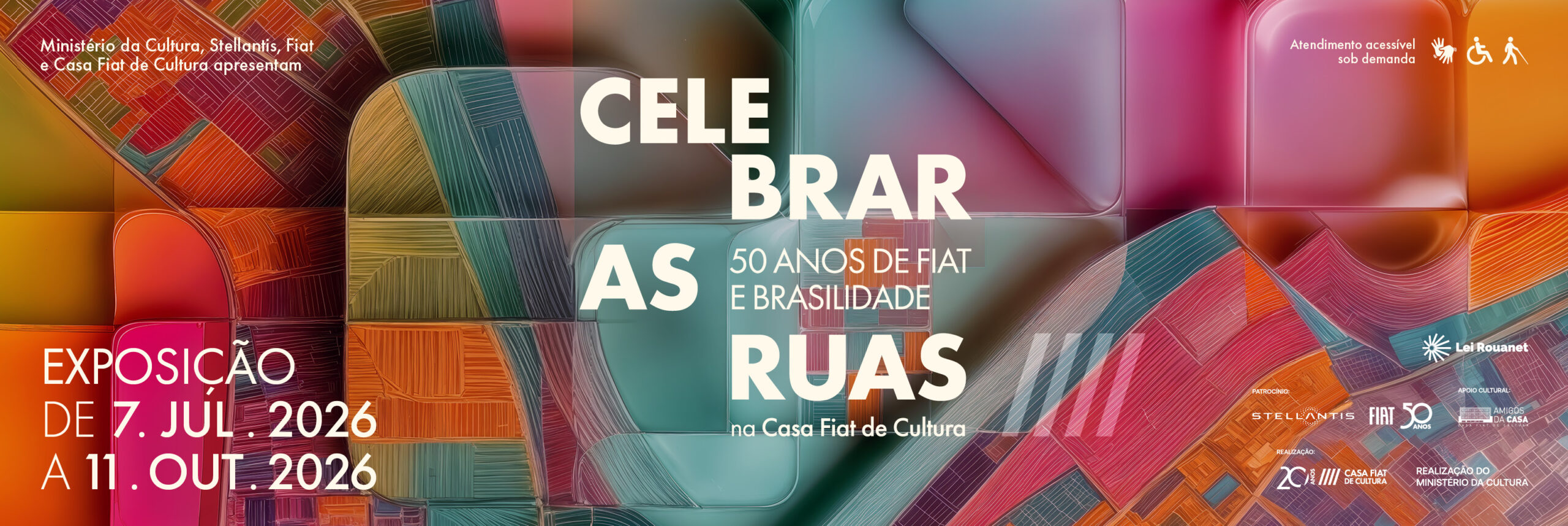
Casa Fiat de Cultura celebrates its 20th anniversary with the exhibition Renoir and presents Celebrar as ruas — 50 anos de Fiat e brasilidade, dedicated to the relationship between the automobile and Brazilian culture.
Praça da Liberdade, nº10, Funcionários | CEP: 30140-010 | Belo Horizonte/MG - Brasil
Tel: +55 (31) 3289-8900
Horário de funcionamento: terça a sexta-feira, das 10h às 21h; sábados, domingos e feriados, das 10h às 18h
Visitas agendadas sob consulta
TODA PROGRAMAÇÃO DA CASA FIAT DE CULTURA É GRATUITA

Atendimento acessível sob demanda, mediante disponibilidade da equipe.
Plano Bianual Casa Fiat de Cultura 2026
